
The Tsuchinoko
The elusive, broad-bodied snake of Japanese folklore
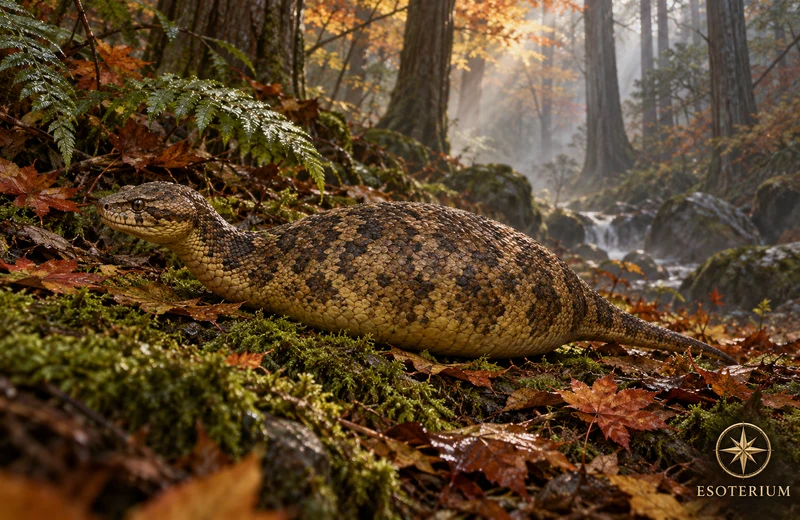
| Also known as | Tsuchinoko, Tsutsu-mamushi, Tokkuri-hebi |
|---|---|
| Region | Japan; Higashishirakawa (Gifu) and Yoshii (Okayama) |
| First sighting | Regional tradition with no verifiable first sighting |
| Type of creature | Folkloric reptile / snake-like cryptid |
| Danger level | ☾☾☾☾☾ |
Something moves among the leaves
Not every creature in a bestiary needs to be a giant. The Tsuchinoko fits into a small woodland clearing: it resembles a snake with a disproportionately broad body, a small head and a tail that suddenly narrows. Its strangeness lies in that compact shape, poised between a familiar animal and something difficult to classify.
The Akaiwa municipal collection of accounts describes lengths of 30 to 80 centimetres, dark colours and a bottle-like torso. It also gathers stories of jumping, moving in straight lines and even snoring. These are features of local tradition, not established behaviour in a proven species.
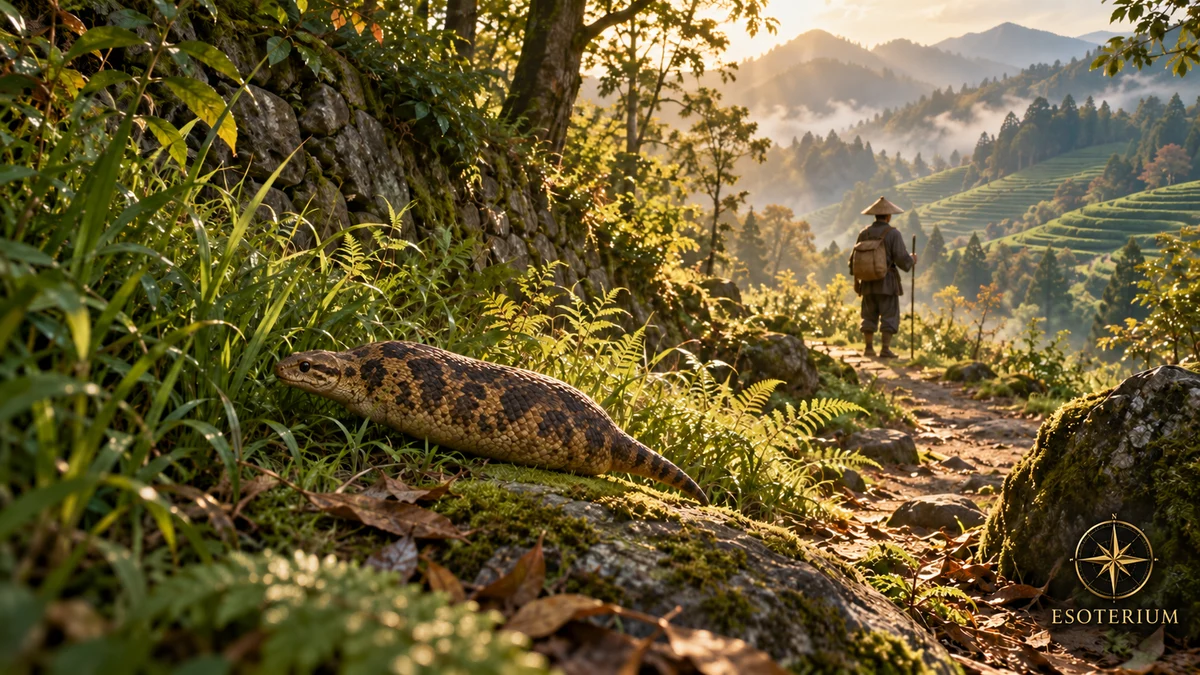

The alleged Yoshii specimen
One particularly specific episode began on May 21, 2000. According to Akaiwa’s published account, a farmer in Kurosawa, in the Yoshii area, encountered a snake-like creature while clearing vegetation beside a rice field. A body found four days later was eventually examined by a biology professor at Kawasaki University of Medical Welfare.
The assessment reported by the municipality suggested that it was probably a yamakagashi, a known snake, although unusual in appearance. The news fuelled local excitement but did not establish a new species. The interest a discovery attracts and the conclusions its examination supports are different things.
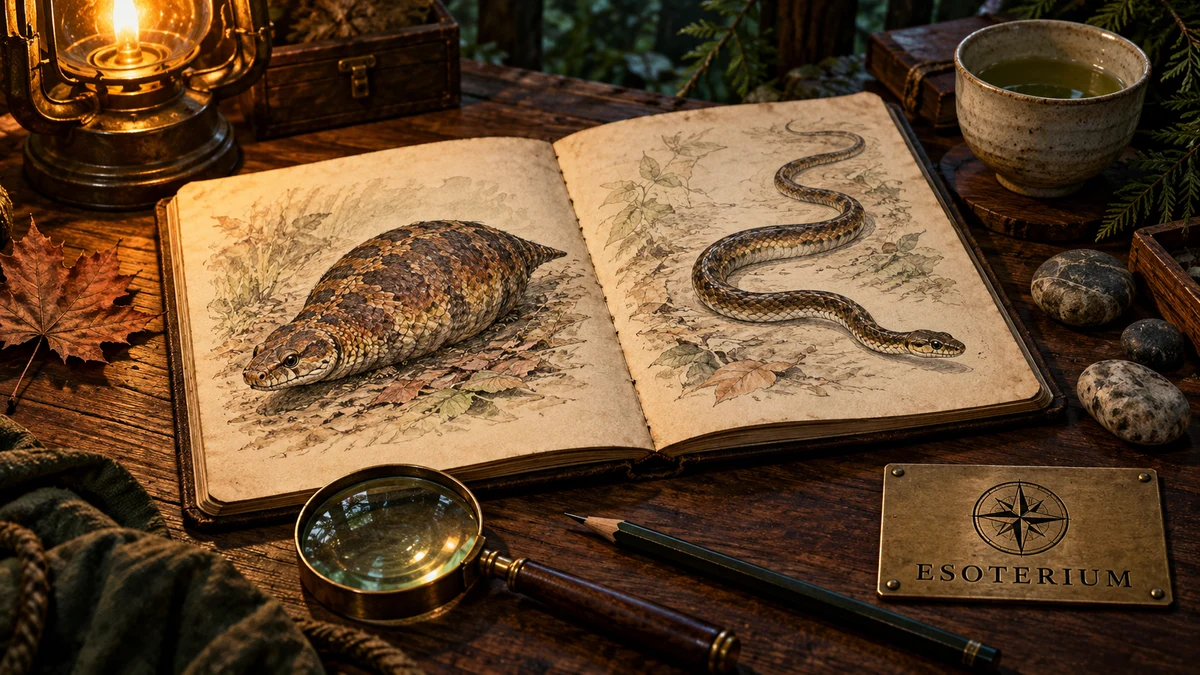
From an outline to evidence
A surprising description raises a question; it does not settle it. Recognising an unknown species would require examinable material, consistent anatomical features and findings that other specialists could check. A popular name or several similar accounts cannot replace that work.
As a general hypothesis, a partly hidden snake may look shorter than it is, while a broad section of its body could dominate a fleeting glimpse. Such possibilities help frame questions but do not identify what was seen in each encounter. The Yoshii case illustrates why each alleged specimen deserves examination before it becomes part of the legend.
A search that brings a village together
In Higashishirakawa, Gifu, the creature is also part of community life. The Tokyo University of Foreign Studies programme for Tomoki Imai’s documentary The Hunt for Tsuchinoko dates the village’s search events to 1989. The film explores witness accounts and rural communities’ relationship with the unknown.
Perhaps that is its appeal: an everyday path still holds the possibility of a surprise. The single danger moon is a narrative rating, not a measure of actual risk. The illustrations on this page are artistic reconstructions; the notebook shown is neither a historical document nor evidence from the case.